Lots of hours have been spent on shaping Playform's terrain, playing with noise functions, isosurface extraction, and brushes. Lately I've been realizing how much of an impact the finer visual details make, starting with the introduction of depth fog. They help break up the monotony of an otherwise pretty homogenous landscape. I plan to bring in landscape features like trees to help too.
Procedural texturing means not having hand-crafted textures ahead of time. Because the terrain can shift and change organically, mapping these textures seamlessly is a bit of a headache. It's not impossible by any stretch (e.g. via Wang tiles). But I'm not convinced I want preconstructed assets at all - I think eventually, I'd like the user to be able to paint the terrain, much like how they can sculpt it. I want some cheap, easy, and decent-looking texturing there as a base, but I don't want the user married to it.
Noise
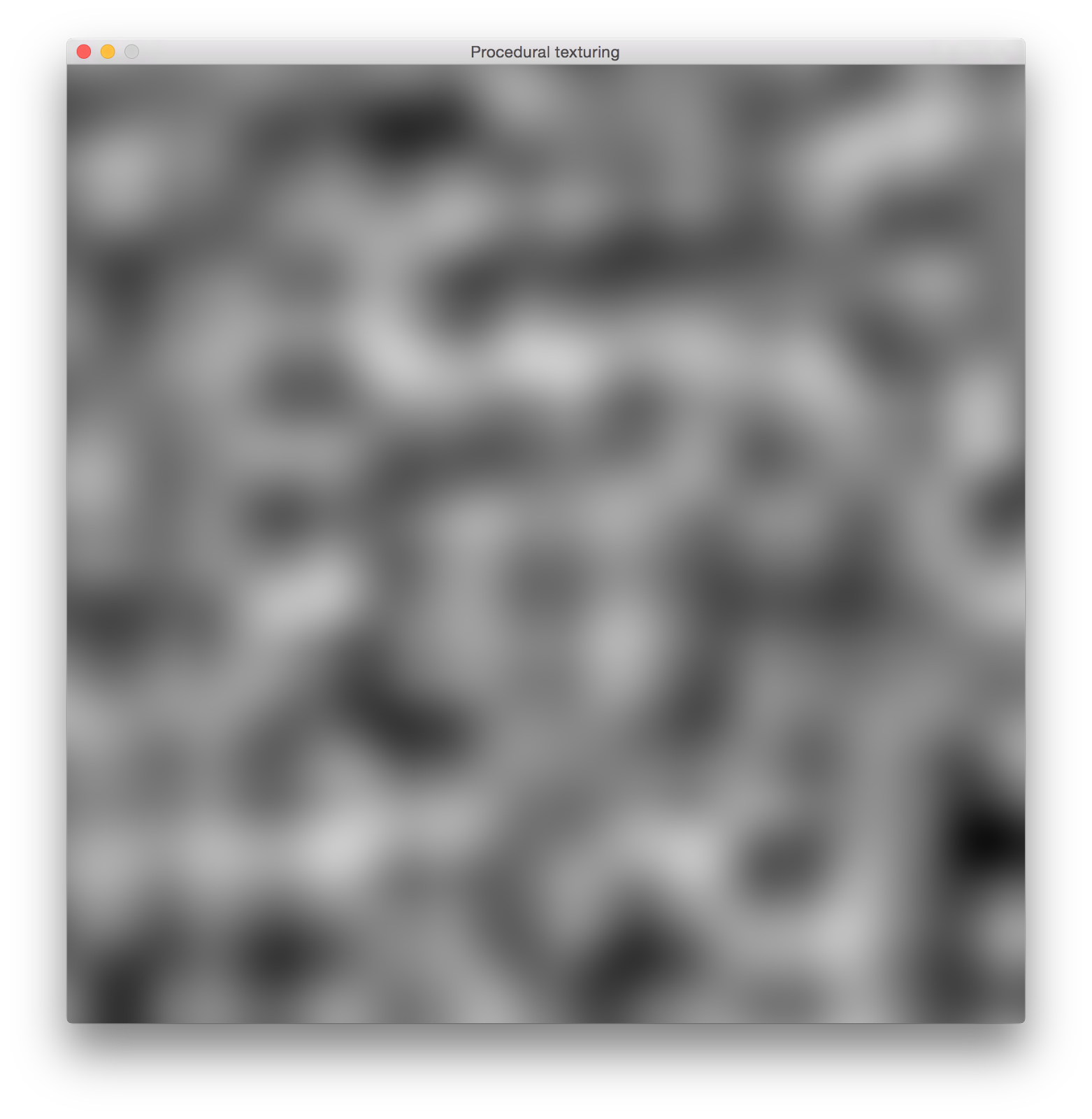
So how do we make a cheap, easy, and decent-looking texture from nothing? The solution is to find some smooth noise function, and twist and turn it into the desired texture. Lots of noise functions exist (Perlin noise is probably the most well-known), and there are even some built right into GLSL, the OpenGL shader language, but I ended up using this one for performance reasons, and because I'm not too nitpicky about the details as long as it's smooth and kind of bubbly looking. Here's a little patch of noise:
I'm still figuring out how to transform this basic thing, and how to think about stacks of transformations, but I've adopted Miguel Cepero's approach of adding layers until it looks halfway-decent. Here's what I've got so far. I suggest clicking to see the full-size images.
Dirt
Grass
Bark
I'm still having trouble getting things to look more jagged. The bark texture is the closest I've gotten (and I wasn't even trying to make bark - I was going for a dirt texture like this). Maybe I should just be using a different noise function for more jagged things. I'm not well-read on noise functions, so to my smooth bubbly mind, everything looks like a sinusoidal nail.
The code is up at github.com/bfops/procedural-textures. I encourage you to play around and try and make some better-looking things!
Sunday, August 30, 2015
Saturday, August 29, 2015
Voxel brushes
Playform now comes equipped with voxel brushes! They are very rough and very buggy, and the only one exposed directly to the user is a sphere brush, but the core functionality is still there.
This has been slowly in the works for over a month, and things were crashing pretty consistently for most of that time.
One big source of crashes was the code that turns the terrain voxels into a surface mesh (see this post). One invariant of that code is that if a voxel edge crosses the terrain surface, all the voxels containing that edge must be aware that they too cross the terrain, and keep extra data around to help build the mesh. It turns out it's really easy to violate that invariant if you're not being careful, and I wasn't. Another source of problems was that sometimes the "eraser" brush would expose parts of the world that hadn't been evaluated yet, because they'd been buried underground, and therefore weren't relevant to creating the mesh. Yet another series of crashes came up when a brush ended exactly between two voxels, because then they would "disagree" about whether they were crossing the terrain surface. After lots of debug logs and code comments, a version was reached that didn't constantly crash. It's still far from perfect, but it kindasortamaybesometimes works enough that I'm considering it functional for now, and doing other things for a while.
I started with a cube brush, because it's easy to define a cube and test whether it intersects various other things (especially points and cube-shaped voxels). This ended up being great since it exercised a lot of edge cases (pun intended), because the numbers were "too perfect". The sphere brush gave me an unreasonable amount of headache, because I couldn't find a clever way to place points inside some voxel that rested on the surface of some sphere (said another way: it's easy to pick some point inside a given voxel that rests on the surface of a given sphere, but it's a lot harder to find a good point that will make the mesh look nice). In the end, I just approached it from the point of view of "you have some shape, find a point on it", and reworked the terrain generation code that has to deal with exactly the same problem.
This has been slowly in the works for over a month, and things were crashing pretty consistently for most of that time.
One big source of crashes was the code that turns the terrain voxels into a surface mesh (see this post). One invariant of that code is that if a voxel edge crosses the terrain surface, all the voxels containing that edge must be aware that they too cross the terrain, and keep extra data around to help build the mesh. It turns out it's really easy to violate that invariant if you're not being careful, and I wasn't. Another source of problems was that sometimes the "eraser" brush would expose parts of the world that hadn't been evaluated yet, because they'd been buried underground, and therefore weren't relevant to creating the mesh. Yet another series of crashes came up when a brush ended exactly between two voxels, because then they would "disagree" about whether they were crossing the terrain surface. After lots of debug logs and code comments, a version was reached that didn't constantly crash. It's still far from perfect, but it kindasortamaybesometimes works enough that I'm considering it functional for now, and doing other things for a while.
I started with a cube brush, because it's easy to define a cube and test whether it intersects various other things (especially points and cube-shaped voxels). This ended up being great since it exercised a lot of edge cases (pun intended), because the numbers were "too perfect". The sphere brush gave me an unreasonable amount of headache, because I couldn't find a clever way to place points inside some voxel that rested on the surface of some sphere (said another way: it's easy to pick some point inside a given voxel that rests on the surface of a given sphere, but it's a lot harder to find a good point that will make the mesh look nice). In the end, I just approached it from the point of view of "you have some shape, find a point on it", and reworked the terrain generation code that has to deal with exactly the same problem.
Terrain, voxels, and meshes
Defining the terrain
Playform's terrain is defined using some cheap and easy noise functions. The basis is Perlin noise, which is a cheap and easy way of generating smooth, bubbly-looking output, like hilly terrain. A fractional Brownian model is applied to this noise, which is a term I learned just now, and a term I probably won't need to use again for at least another year. It basically just means that I take my Perlin noise, generate it at several amplitudes and frequencies in a fractal pattern (e.g. repeatedly multiplying both by 1/2), and then adding all the results together.
This lets you roughly describe lots of different terrain features pretty easily - mountains are high amplitude and low frequency, where bumps and ditches are low amplitude and high frequency. A nice thing about these fancy-sounding noise functions is that they're popular and well-understood, so finding libraries to generate them (and generate them quickly) isn't hard. Perlin noise can also be used to generate things like textures, which is a thing I've been meaning to work on for a while.
Storing the terrain
Playform's world is divided into a big 3D grid, and each cell can be called a "voxel" (which really just means a 3D pixel). Minecraft and many other games use this idea, so often each cell is considered filled or empty (or equivalently, filled with air). This world representation lets you add and remove pieces "anywhere" in the world without a whole lot of work.
Voxels don't just have to contain simple "full or empty" data; Playform's voxels contain more data so that we know whether each vertex in the grid is inside or outside the terrain. This means that any given grid edge can be entirely inside or outside the terrain (if both its vertices are), or it can be crossing the terrain. The crossing edges are the interesting ones.
This same idea applies to entire grid cells: if all the corners of a cell are on the same side of the terrain, we can just say that the whole voxel is inside/outside, but if it has some corners inside and some outside (or equivalently, if any of its edges cross the terrain), then the voxel intersects the surface of the terrain. Each intersecting voxel stores some extra data to help build the mesh: it stores a point inside that voxel that lies on the surface of the terrain (it doesn't have to be perfect, just approximate). It also stores a surface normal at that point, for lighting and whatnot.
Lastly, this grid isn't stored as a big 3D array; it's stored as an octree (a 3D binary tree). This lets you have bigger cells where less detail is needed (e.g. huge open areas, or huge chunks of space that are entirely inside the terrain), and it gives you the option of having "arbitrarily" smaller cells where more detail is needed.
From voxels to polys
The bulk of the credit for Playform's voxel-to-mesh algorithm goes to this Siggraph 2002 paper and to Miguel Cepero's blog post about exactly this problem.
Whenever we find an edge that intersects the terrain, we generate a little bit of mesh to represent the part of the terrain that is being crossed. We do this by looking at the four grid cells that the edge is a part of. Since the edge is crossing the terrain surface, all of those grid cells must be crossing it too, so they all store a point. We use those four points to construct a little patch of mesh.
This choice of what data to store in each voxel is nice for several reasons. It's pretty simple - a big portion of the work is deciding whether or not a given point is inside the terrain. Deciding where to place points inside the voxels isn't that important algorithmically, it just affects the visual quality of the resulting mesh - you can just put every point in the very center of its "parent" voxel. Curves won't look nice, but it's really easy to calculate. You can calculate surface normals using cross products, since once you have a few points, you also have vectors between those points that are roughly "lying on" the surface. You can make them a little smoother by averaging adjacent normals together.
The mesh points can be placed roughly anywhere inside the voxel, which means you can faithfully represent all kinds of different surfaces. Flat, curvy, pointy, the algorithm really doesn't care, as long as it has some points to work with. One thing I'd like to do is have a mesh import feature (again, credit to Miguel Cepero at Voxel Farm); as long as the grid is high-resolution enough that every mesh vertex is inside its own grid cell, the mesh could be imported without any loss of data, and then made a part of the world!
Depth fog - it makes a difference
Depth fog is the obscuring of objects based on how far they are from the viewer, eventually blending them into the background entirely. Here's a picture of Playform in all its depth-foggy glory:
Here's a roughly side-by-side example of the change. I'm unreasonably proud of how this looks.
Depth fog adds a lot! The code change is incredibly shallow (heh), with only a few extra lines in the shader for a simple exponential drop-off in visibility. I spent much more time tweaking the constants and the curve than I spent writing the code, and that's a nice place to be working in.
It definitely helps me get a sense of distance, and ideally the fog would be tweaked such that the objects at the furthest edge of the viewing distance aren't visible at all. Then they would fade in gradually as you moved closer, instead of aggressively popping in because they've suddenly been loaded. Right now, the bottleneck on view distance is memory consumption - the GPU crunches through the whole mesh in less than a tenth of a millisecond, but the amount of mesh that fits in memory is a little lackluster.
Stay tuned! Coming up hopefully-soon is voxel brushes, better texturing, and voxel materials. I hear trees are also planning a comeback tour.
Ahh.. Playform at dawn
Here's a roughly side-by-side example of the change. I'm unreasonably proud of how this looks.
Without depth fog
With depth fog
Depth fog adds a lot! The code change is incredibly shallow (heh), with only a few extra lines in the shader for a simple exponential drop-off in visibility. I spent much more time tweaking the constants and the curve than I spent writing the code, and that's a nice place to be working in.
It definitely helps me get a sense of distance, and ideally the fog would be tweaked such that the objects at the furthest edge of the viewing distance aren't visible at all. Then they would fade in gradually as you moved closer, instead of aggressively popping in because they've suddenly been loaded. Right now, the bottleneck on view distance is memory consumption - the GPU crunches through the whole mesh in less than a tenth of a millisecond, but the amount of mesh that fits in memory is a little lackluster.
Stay tuned! Coming up hopefully-soon is voxel brushes, better texturing, and voxel materials. I hear trees are also planning a comeback tour.
Sunday, March 15, 2015
Cap'n Proto Rust Macros
I've found Rust is pretty good at designing powerfully for the common use case while still smoothly supporting uncommon ones.
The macro system is another good example. Macros are pretty effective for a lot of the macro-y use cases: you can use them as inline functions, you can use them to parse varargs, and you can use them to create tree-style DSLs, like this example taken from the Rust guide:
I used macros to make a DSL like that for Cap'n Proto message construction code, and I'm pretty happy with the results. This is the example from capnpc-rust:
And here's how it looks using capnpc-macros:
unsafe is a great example: Rust provides tons of tools to keep yourself from shooting yourself in the foot in ways that are common in C++, like null pointers and pointers to expired data. But if what Rust provides doesn't work for you, for whatever reason (e.g. your data ownership is complicated enough that you can't explain it to the compiler), then you can opt out of these things using unsafe. You, as the programmer, accept the responsibility for the things you've given up.
The macro system is another good example. Macros are pretty effective for a lot of the macro-y use cases: you can use them as inline functions, you can use them to parse varargs, and you can use them to create tree-style DSLs, like this example taken from the Rust guide:
let mut out = String::new();
write_html!(&mut out,
html[
head[title["Macros guide"]]
body[h1["Macros are the best!"]]
]);
assert_eq!(out,
"<html><head><title>Macros guide</title></head>\
<body><h1>Macros are the best!</h1></body></html>");
I used macros to make a DSL like that for Cap'n Proto message construction code, and I'm pretty happy with the results. This is the example from capnpc-rust:
let mut message = MallocMessageBuilder::new_default();
{
let address_book = message.init_root::<address_book::Builder>();
let mut people = address_book.init_people(2);
{
let mut alice = people.borrow().get(0);
alice.set_id(123);
alice.set_name("Alice");
alice.set_email("alice@example.com");
{
let mut alice_phones = alice.borrow().init_phones(1);
alice_phones.borrow().get(0).set_number("555-1212");
alice_phones.borrow().get(0).set_type(person::phone_number::Type::Mobile);
}
alice.get_employment().set_school("MIT");
}
{
let mut bob = people.get(1);
bob.set_id(456);
bob.set_name("Bob");
bob.set_email("bob@example.com");
{
let mut bob_phones = bob.borrow().init_phones(2);
bob_phones.borrow().get(0).set_number("555-4567");
bob_phones.borrow().get(0).set_type(person::phone_number::Type::Home);
bob_phones.borrow().get(1).set_number("555-7654");
bob_phones.borrow().get(1).set_type(person::phone_number::Type::Work);
}
bob.get_employment().set_unemployed(());
}
}
And here's how it looks using capnpc-macros:
let mut message =
capnpc_new!(
address_book::Builder =>
[array init_people 2 =>
[
[set_id 123]
[set_name "Alice"]
[set_email "alice@example.com"]
[array init_phones 1 =>
[
[set_number "555-1212"]
[set_type {person::phone_number::Type::Mobile}]
]
]
[init_employment => [set_school "MIT"]]
]
[
[set_id 456]
[set_name "Bob"]
[set_email "bob@example.com"]
[array init_phones 2 =>
[
[set_number "555-4567"]
[set_type {person::phone_number::Type::Home}]
]
[
[set_number "555-7654"]
[set_type {person::phone_number::Type::Work}]
]
]
[init_employment => [set_unemployed ()]]
]
]
);
I think that's pretty cool.
Update: Client/Server Refactoring
The client/server refactoring is done for now! It took about a month, but Playform has been split into separate server and client binaries that communicate over sockets. Hypothetically, this should work over LAN too, but I haven't tested it.
Async IO Design
A huge portion of the work went into creating a predictable and performant async IO design, that lets you explicitly prioritize different kinds of events (e.g. prioritizing world updates and client inputs over terrain loading).
The Journey: For a while, I tried using an "intuitive" approach to threading, where each conceptually independent line of work (e.g. terrain loading, client update processing, world updating) ran in a separate thread. But it was hard to control which thread ran at which time, so terrain loading would interrupt world updating at unhelpful times. It's not really reasonable or helpful for all those independent lines of work to be treated equally. It's not at all impossible to coordinate threads with one another (e.g. by using condition variables to have threads signal each other), but it just seemed like too much work. I'd be trying to describe the relationships between threads by defining individual actions between them; I imagine that's like trying to draw a picture in Conway's game of life: doable, but unnecessarily hard. If you want to describe a picture, just describe the picture.
The Result: There's that old rule of thumb about multithreading that says if any nontrivial portion of the work you do is serial, then the speedup you get from multithreading will be incremental. That basic idea lingered in my head throughout the whole redesign. I felt like although I could try to jump straight to an inherently-multithreaded design, it might work better to try and get a design that works pretty well in a single thread, that can have more threads added to it, i.e. a design where the work being done is independent of the threads doing it. I went back to having a single (main) thread for the client and server, plus message-handoff threads that look like:
These threads are basically always blocked, since they're either waiting for incoming message (so blocked on interrupts) or sending a message (so probably blocked on a
The server's main thread looks like:
The
The client has a similar main thread. If you wanted to process two of the actions above at the same priority, you could just merge the message queues into a single queue. So far, that hasn't been particularly necessary: realistically, we should be "running out" of world updates and client updates on a really frequent basis (i.e. several times a second), so none of the actions get starved. If we assume that's happening, then the exact ordering doesn't matter anyway.
This design is also easy to scale to multiple threads; I can just add a new thread with the same
The last 20%
The async IO redesign was a big chunk of the client/server refactoring, but a few more things needed to happen to get performance back to where it was before - I wanted to be able to run a local server and local client and have the same smoothness I had when they were bundled together in the same process.
Message-passing: A big bottleneck that came up was the message-passing between client and server: they communicate over sockets (since, ideally, I want this to also work over at least LAN), so before, where we could just pass data by passing a pointer, now we actually need to send data, byte-by-byte, in a serialized format (no pointers for things like dynamic arrays!) I was using JSON originally, just because it's easy and built in to the standard library, but it was too verbose and too slow. I tried to use Cap'n Proto, but the refactoring to make it work was getting to be too much (I did get a cool new repo out of it, though). I ended up just writing my own "Flatten" trait to turn data types into "flat" memory blocks, and using that.
Rate limiting: The client asks the server to send it all the blocks of terrain it wants to load. The end goal for the client is "load all blocks within some radius R". We could just send a "gimme all blocks within radius R" packet to the server, but if we move a little to the right, we don't want to get all those blocks again. Ideally, we could just ask for the new "slice" of blocks, but we also don't have any guarantee that all the previous ones finished loading, or what order they loaded in (since the server could really send them back in any order, regardless of the requested order - we want to load blocks as soon as they're available, don't we?) So although it might be possible to avoid individually requesting blocks all the time, the amount of work we'd have to do in order to request in bigger "chunks" doesn't seem worth it. Instead, let's just handle that huge stream of requests better. More compact, efficient serialization was a big part of it. Handling terrain loading as a lower-priority action was another big step, since handling client terrain requests as part of the client update action would lag all the event processing from the client (e.g. you'd press W and the player wouldn't move because the server was still busy dealing with your client's terrain requests). But there were still too many actions; the client updates were still being slowed down by all the terrain requests. The obvious, simple, functional solution was just to rate-limit the client. Ideally, this would be done on the server's end (since we have to do that eventually for security reasons anyway), but for now, rate limiting on the client's end is good enough - just don't be as eager about sending requests.
Don't be an idiot: The one last optimization that made a big difference was some of the more low-hanging fruit I could've found: at some point during the switch (or maybe it's been this way the whole time), I accidentally removed the code that would filter out requests for blocks that were already loaded. When the client moved a few steps in any direction, we'd re-request roughly
Async IO Design
A huge portion of the work went into creating a predictable and performant async IO design, that lets you explicitly prioritize different kinds of events (e.g. prioritizing world updates and client inputs over terrain loading).
The Journey: For a while, I tried using an "intuitive" approach to threading, where each conceptually independent line of work (e.g. terrain loading, client update processing, world updating) ran in a separate thread. But it was hard to control which thread ran at which time, so terrain loading would interrupt world updating at unhelpful times. It's not really reasonable or helpful for all those independent lines of work to be treated equally. It's not at all impossible to coordinate threads with one another (e.g. by using condition variables to have threads signal each other), but it just seemed like too much work. I'd be trying to describe the relationships between threads by defining individual actions between them; I imagine that's like trying to draw a picture in Conway's game of life: doable, but unnecessarily hard. If you want to describe a picture, just describe the picture.
The Result: There's that old rule of thumb about multithreading that says if any nontrivial portion of the work you do is serial, then the speedup you get from multithreading will be incremental. That basic idea lingered in my head throughout the whole redesign. I felt like although I could try to jump straight to an inherently-multithreaded design, it might work better to try and get a design that works pretty well in a single thread, that can have more threads added to it, i.e. a design where the work being done is independent of the threads doing it. I went back to having a single (main) thread for the client and server, plus message-handoff threads that look like:
let mut listen_socket =
ReceiveSocket::new(
listen_url.clone().as_slice(),
Some(Duration::seconds(30)),
);
loop {
let msg = listen_socket.read();
server_recv_thread_send.send(msg).unwrap();
}
These threads are basically always blocked, since they're either waiting for incoming message (so blocked on interrupts) or sending a message (so probably blocked on a
memcpy). They don't spend a whole lot of time actually doing anything, so I pretty much ignore them (let me know if that'll get me into trouble).
The server's main thread looks like:
in_series!(
{
let updates =
server.update_timer.lock().unwrap().update(
time::precise_time_ns()
);
if updates > 0 {
update_world(
...
);
true
} else {
false
}
},
{
listen_thread_recv.lock().unwrap().try_recv_opt()
.map_to_bool(|up| {
let up = binary::decode(up.as_slice()).unwrap();
apply_client_update(
...
);
})
},
{
gaia_thread_recv.lock().unwrap().try_recv_opt()
.map_to_bool(|up| {
update_gaia(
...
)
})
},
);
The
in_series macro runs its parameter "actions" in top-down order until one of them succeeds, then returns to the top of the list. If none of the functions succeeds, it explicitly yields the thread. The result is that it runs the top action until it fails, then for as long as it fails, it runs the next action until it fails, and so on. So the server's main thread updates the world at a regular interval (e.g. update players, mobs, move the sun, etc.). If there's time available, it'll process events from the listen socket. With any remaining time, we process terrain load requests. Terrain requests are separate from world updates because they're less critical and cost more CPU time. That said, the world updates (top priority) decide what terrain to load, and load solid placeholder blocks until the terrain is loaded, so, for instance, the player won't fall through the world if the terrain gen is too slow.
The client has a similar main thread. If you wanted to process two of the actions above at the same priority, you could just merge the message queues into a single queue. So far, that hasn't been particularly necessary: realistically, we should be "running out" of world updates and client updates on a really frequent basis (i.e. several times a second), so none of the actions get starved. If we assume that's happening, then the exact ordering doesn't matter anyway.
This design is also easy to scale to multiple threads; I can just add a new thread with the same
in_series-based code; the message queues and server data are Mutex-wrapped to be thread-safe, so the threads can run pretty independently (I still want to put in more work on the locking side of things, so threads are less likely to subtly/unintentionally block one another). The one major wrinkle is when some things need to be single-threaded, like OpenGL calls in the client (I've been operating under the assumption that the OpenCL calls for terrain generation work the same way). In that case, you can just remove those actions from the in_series invocations of all but one thread.
The last 20%
The async IO redesign was a big chunk of the client/server refactoring, but a few more things needed to happen to get performance back to where it was before - I wanted to be able to run a local server and local client and have the same smoothness I had when they were bundled together in the same process.
Message-passing: A big bottleneck that came up was the message-passing between client and server: they communicate over sockets (since, ideally, I want this to also work over at least LAN), so before, where we could just pass data by passing a pointer, now we actually need to send data, byte-by-byte, in a serialized format (no pointers for things like dynamic arrays!) I was using JSON originally, just because it's easy and built in to the standard library, but it was too verbose and too slow. I tried to use Cap'n Proto, but the refactoring to make it work was getting to be too much (I did get a cool new repo out of it, though). I ended up just writing my own "Flatten" trait to turn data types into "flat" memory blocks, and using that.
Rate limiting: The client asks the server to send it all the blocks of terrain it wants to load. The end goal for the client is "load all blocks within some radius R". We could just send a "gimme all blocks within radius R" packet to the server, but if we move a little to the right, we don't want to get all those blocks again. Ideally, we could just ask for the new "slice" of blocks, but we also don't have any guarantee that all the previous ones finished loading, or what order they loaded in (since the server could really send them back in any order, regardless of the requested order - we want to load blocks as soon as they're available, don't we?) So although it might be possible to avoid individually requesting blocks all the time, the amount of work we'd have to do in order to request in bigger "chunks" doesn't seem worth it. Instead, let's just handle that huge stream of requests better. More compact, efficient serialization was a big part of it. Handling terrain loading as a lower-priority action was another big step, since handling client terrain requests as part of the client update action would lag all the event processing from the client (e.g. you'd press W and the player wouldn't move because the server was still busy dealing with your client's terrain requests). But there were still too many actions; the client updates were still being slowed down by all the terrain requests. The obvious, simple, functional solution was just to rate-limit the client. Ideally, this would be done on the server's end (since we have to do that eventually for security reasons anyway), but for now, rate limiting on the client's end is good enough - just don't be as eager about sending requests.
Don't be an idiot: The one last optimization that made a big difference was some of the more low-hanging fruit I could've found: at some point during the switch (or maybe it's been this way the whole time), I accidentally removed the code that would filter out requests for blocks that were already loaded. When the client moved a few steps in any direction, we'd re-request roughly
render_distance^3 blocks, instead of roughly render_distance^2. That made a pretty noticeable difference, and gave the performance that last push back to smoothness!
Monday, March 2, 2015
Stripping Down the Scheduler
In my last post, I laid out a high-level client/server design based around a custom scheduler enqueuing and prioritizing closures. The basic idea is still sound, but somewhat surprisingly (at least to me) the "closure" part of this design is the least relevant one.
All the queued closures would originate from somewhere: either incoming messages, or by timed signals. If we allocate a closure for every single event, it means a whole lot of small, repetitive heap allocations. We can take down the churn a little by batching up messages, but we sacrifice some flexibility and latency.
But more importantly, why use closures at all? The set of things causing a closure is small and well-defined - we can keep the priority- and deadline-based approach, but we can implement it on run-of-the-mill message queues too. We have to add a few
Once again, I find myself bitten by trying to think too generically.
All the queued closures would originate from somewhere: either incoming messages, or by timed signals. If we allocate a closure for every single event, it means a whole lot of small, repetitive heap allocations. We can take down the churn a little by batching up messages, but we sacrifice some flexibility and latency.
But more importantly, why use closures at all? The set of things causing a closure is small and well-defined - we can keep the priority- and deadline-based approach, but we can implement it on run-of-the-mill message queues too. We have to add a few
enums to describe the messages, but that's okay. Then a fixed-size task pool can pop and process the prioritized events just like before.
Once again, I find myself bitten by trying to think too generically.
Subscribe to:
Posts (Atom)


